


Steptoe and Son
1962 United KingdomSteptoe and Son, one of the crown jewels in British television history, began modestly as a one-off play entitled The Offer, part of the BBC’s lauded Comedy Playhouse series. What followed was nothing short of revolutionary: a character-driven sitcom that dared to explore the murky emotional hinterland between laughter and heartbreak – a balancing act that had not previously been attempted with any depth or success, but one which would become the enduring template of so many that followed it.
At the heart of the series were two unforgettable characters: Albert Steptoe, the gloriously repugnant "dirty old man" with his perpetually filthy mittens, played with pitch-perfect grotesquery by Dublin-born Wilfrid Brambell; and his long-suffering, thwarted son Harold, brought to life in a masterclass of performance by Harry H. Corbett. Together, the pair operated as rag-and-bone men in Shepherd’s Bush – a seemingly humble set-up that belied the complex and layered psychological interplay that unfolded week after week.
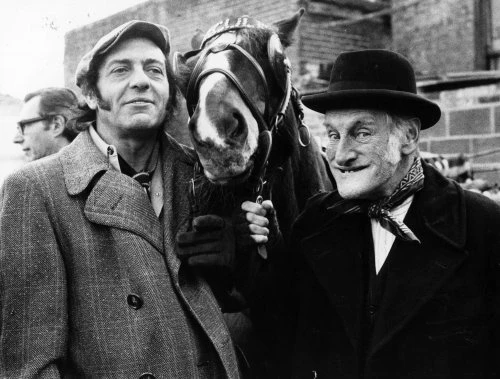
The genius of writers Galton and Simpson – already revered for their work on Hancock's Half Hour – was to tap into a raw, universal truth: apparent to the viewers if not the Steptoe's themselves, of their sadly obvious co-dependence. The older Albert and the younger Harold were two sides of the same coin, neither whole without the other, no matter how much they affected an air of mutual dislike. It was this essential truth, coupled with consistently excellent scripts and performances from two actors who quite obviously understood the subtle subtext of the concept, which ensured a continuity of comedic quality rarely surpassed in television to this day.
Though Harold dreamt of escape – to better himself through art, culture, or love – he remained irrevocably tethered to his manipulative and emotionally parasitic father. And yet, beneath the bickering and bitterness, the unspoken, uncomfortable truth was that they needed each other. The series drew much of its power from this paradox, crafting a portrait of human entanglement that was both hilarious and profoundly sad.
This complex emotional terrain was handled with a deftness rare in comedy. The scripts were masterful in their economy, allowing both actors to wring every ounce of meaning from a glance, a pause, or a mumbled line. The result was a form of tragicomedy that elevated the genre, pushing the boundaries of what situation comedy could achieve.
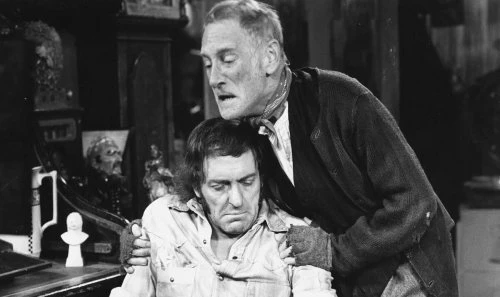
Running from 1962 to 1974, the show not only became a fixture of British popular culture but also set the benchmark against which all future sitcoms would be measured. Its popularity spawned two feature films – Steptoe and Son (1972) and Steptoe and Son Ride Again (1973) – as well as radio adaptations, Pye Records releases, and specially written sketches for Christmas specials and even a Royal Variety Performance alongside The Beatles. Brambell, incidentally, would go on to appear in A Hard Day’s Night as Paul McCartney’s grandfather, a role played in deliberate contrast to his famously grubby TV persona, an in-joke being the repeated observation, “he’s very clean.”
Internationally, Steptoe and Son inspired various adaptations, most notably the American remake Sanford and Son, which enjoyed considerable success in its own right. But it’s the original – with all its stubborn Britishness, melancholy, and moments of genuine beauty – that endures.
Tragically, any prospect of further visits to Oil Drum Lane, ended with Corbett’s premature death. Yet the series continues to find new audiences through television repeats and DVD releases, and its legacy is untarnished. In 1999, Galton and Simpson were rightly honoured in the Queen’s New Year’s Honours list – a fitting tribute to the writers of some of television’s finest scripts, and arguably the founding fathers of the modern sitcom.
Ultimately, Steptoe and Son may have portrayed two men surrounded by junk, but what they offered the viewing public was nothing less than treasure. In its pathos, wit, and brutal honesty, the series remains a towering achievement in British comedy – and a reminder that even in the grubbiest corners of life, there is something priceless to be found.
Seen this show? How do you rate it?
Seen this show? How do you rate it?
Share on...
Published on February 4th, 2019. Written by Marc Saul "You dirty old man!" (2025) for Television Heaven.


